The song, titled “Everything is Music,” reflects Rumi’s Pantheistic belief, which posits that the essence of the divine is a single, universal substance and spirit, the cause of everything.
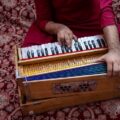
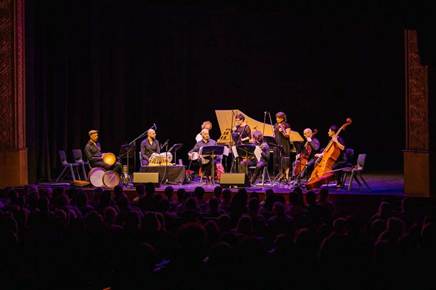
The ethereal Whirling Dervishes, a symbol of Rumi’s belief in the spinning of everything from a speck of dust to mountains, oceans, and stars, represent the rapturous reverences of the divine. The healing voice of Siar Hashimi intertwines with the austere, melodious beauty of Nainawaz’s Reed Song. The music of Rubab improvisations reverberates in a gracefully shifting pulse and mode, adding to the overall musical experience.
The spectacular performances of the beloved Afghan Rubab on stages in Hobart, Melbourne, Sydney, and other Australian cities transported audiences to a corner of Afghanistan. The repertoire of Afghan Rubab—an inimitable match to Baroque cross-rhythms, cascading scale motion, and heart-touching ornaments of Gaspar Sanz—captivated audiences. Virtuoso Rubab player Khalid Arman’s recent tour enthralled numerous Australians with his stunning Rubab artistry and the intricacies of Afghan music, showcasing the quixotic Baroque style that linked the emotional attraction of the Kabul Ensemble.
The penetrating wailing and ecstatic joyful sounds of the Afghan Rubab began to attract Western attention. The Spanish ensemble Casa del Mar produced a remarkable fusion of the Afghan rubab with the popular Spanish song “Hijo de la luna,” understanding the Rubab’s far-reaching, cross-cultural appeal and incorporating it into their repertoire. This innovative approach has led to the flourishing of the Rubab in Europe and North America, with Afghan Rubab soloists expanding its reach and captivating audiences with their talent. Some of the finest Western musicians have also embraced the Rubab, adding to its growing popularity.
Khalid Arman further enriched the Rubab’s capabilities by innovatively restructuring its fretboard. His efforts have undoubtedly sparked passion among Westerners and solidified the Rubab’s place alongside the Indian sitar as an iconic national musical instrument. Plato, centuries before, recognised the far-reaching potential of music, stating, “Music gives a soul to the universe, wings to the mind, flight to the imagination, and life to everything.”
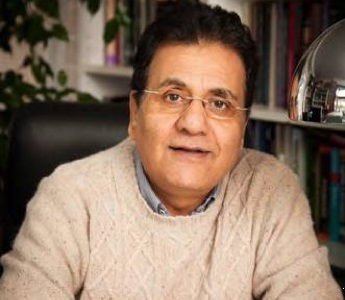
Dr Ehsan Azai Stanizai is the director of the Sydney Lacan Study and Reading Network.
About the Author